
Easy Gooseberry Jelly Recipe
This post may contain affiliate links. Read our disclosure policy.

Gooseberry Jelly just became a delicious part of our summer and fall. Here’s how I’m making the jelly with a lower-sugar recipe!

Why make homemade gooseberry jelly?
Gooseberries are plentiful (and free!) for us where we live. If you can get your hands on some, the reward is well worth it. Making Gooseberry Jelly can be a great way to fill your pantry for the winter.
Ingredients & equipment
- Gooseberries – You can use the berries is various stages of ripeness from greenish to almost black. We prefer the darkest ones as they are the easiest to pick and have the most juice.
- Sugar or Honey
- Pomona’s Pectin – My recipe uses this because this is the only pectin I use. The great thing is we can use less sugar in our final product! I highly recommend it. You can get the small boxes or buy it in bulk.
- Equipment: steam juicer, stockpot or saucepan, water bath canner, jars, lids, rims, etc.

Step‑by‑Step Instructions

Unless you are really lucky and someone has gifted you berries, you need to start by picking. Be sure and wear gloves and use a berry picker. This is the style berry picker I have.

Start the jelly process by washing your fruit. If you are using a steam juicer like I am in this tutorial, you don’t need to remove all the leaves and stems. I highly recommend this method.
Using a mixture of colors will result in a lighter, tangier jelly. Using all dark berries will be a richer, darker jelly. Both are good!

Add the berries to your steam juicer and follow the instructions on your model to extract all the juice. I usually run mine for about an hour and a half to get all the juice out.

Measure whatever amount of juice you get so you know how many vups before you add it into your saucepan. Add 1 teaspoon of calcium water per cup of juice (from the Pomona’s Pectin box). Bring the juice to a low boil.

While you are waiting for the juice to boil, mix your sugar or honey with the powdered pectin. I add 1/2 of cane sugar per cup of juice to gooseberry jelly. Once the juice has come to a boil, you can slowly whisk in your sweetener. Bring the jelly back to a boil before turning off the heat.

Add the jelly to clean jelly jars. Clean the jar rims before placing the lid and ring on the top, securing it to a fingertip tightness.

Place the jars in a boiling water bath canner. See the altitude adjustment below for times. (I boil mine for 18 minutes.)


Remove the jars and let them cool and seal undisturbed for at least 12 hours. If one does not seal, just stick it in the fridge and enjoy now. All sealed jars are shelf-stable and can be stored in the pantry.

Variations & Serving Ideas
- Combine gooseberries with red currants or other berries for a flavor twist.
- Ideas for gooseberry jelly beyond toast: glaze for meat, filling for pastries, swirl into yogurt.
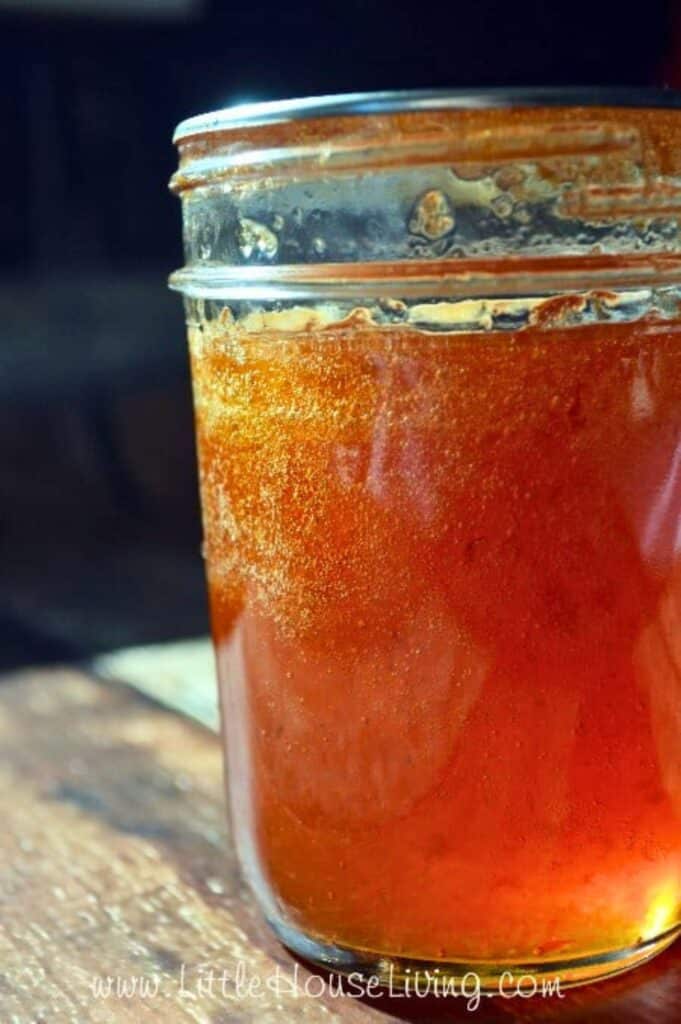
- Use various shades of berries for a brighter red jelly. (pictured above)

Frequently Asked Questions (FAQ)
- Can I use frozen gooseberries? Yes, you can freeze gooseberries until you have enough to make jelly.
- How much sugar per cup of juice? I use 1/2 cup of sugar per cup of juice with the Pomonas Pectin.
- Do I need pectin? Yes, gooseberry juice needs pectin to set.
- What if my jelly doesn’t set? You can use it as syrup instead! 🙂
More Homemade Jellies and Jams
- Jalapeno Pepper Jelly Recipe
- 22 Jam and Jelly Recipes to Make This Summer
- Homemade Strawberry Jam Recipe
- Strawberry Rhubarb Jam (Butter)
- Sweet & Tasty Apple Pie Jam Canning Recipe

Merissa Alink
Merissa has been blogging about and living the simple and frugal life on Little House Living since 2009 and has internationally published 2 books on the topic. You can read about Merissa’s journey from penniless to freedom on the About Page. You can send her a message any time from the Contact Page.
I have never even seen gooseberries or know anyone who has any?? I will Google it and check around. But sure sounds tasty. I make lots of blueberry everything.
They are in the currant family but we actually think that taste more like a tart concord grape. 🙂